Anita Flare is a skilled tool and die worker. She has been working for Car Parts Inc., a large manufacturer of parts for the automobile industry for over 10 years. Car Parts Inc. is a Canadian-controlled private corporation. Anita has become their "Jane on the Spot" as far as diagnosing and quickly retooling machinery that breaks down or needs to be updated to run a short order. Anita is single and she rents a home in north Toronto. Because Anita is required to travel for 75% of the year, Car Parts Inc. actually pays the $1,200 monthly rent on Anita's home in Toronto. Anita reimburses the company for 25% of this amount ($300 per month) through payroll deduction as set out below.
The head office of Car Parts Inc. is located in north Toronto. The company, however, has plants that are located throughout Ontario and Quebec, wherever there are large automobile manufacturing operations to be supplied with parts. When a plant requires emergency retooling or repair Anita is sent out to that location to supervise and organize the work. As stated above, this involves about 75% of Anita's total employment hours for any given year. She stays at a particular location for a period of days or weeks depending on the nature of the job involved. She is never at a site for less than 36 hours. For the balance of the year, Anita works at the head office in the research department.
Anita's final 2012 pay stub showed the following totals for the year.
Gross salary………………………………………………………..………………$115,000
Payroll deductions:
Income tax withheld……………………………….…………..………………………$44,200
Canada Pension Plan contributions………………………………………….……………2,307
Contributions to company group RRSP………………………………………………..…1,750
RPP contributions on account of current service…………………………………….……5,000
Union dues to Canadian Union of Automobile Workers (HST exempt) ………………… 800
Group accident income protection insurance premiums (matched by company) ………… 240
Monthly rent reimbursement (as described above) ……………………………………… 3,600
In discussion with Anita you determined that the company also provides the following fringe benefits.
Payment of board and lodging costs at special work sites as required — at cost
To company…………………………….…………………………………..$18,000
Bonus based on company profits for the year above budgeted targets ……..12,500
Provision of safety boots and company uniform consisting of five shirts and five matching pairs of pants; the shirt is embroidered with her name on
The front pocket and has the company name on the back……………450
Registered pension plan contributions to defined benefit plan…….6,750
Monthly allowance of $150 to cover personal phone calls, laundry costs and other incidentals while travelling. (She estimates that she spends $100
Per month) ……………………………………………….1,800
Fitness club membership dues to a club with locations across Ontario (including HST); Anita feels that it is important to her productivity to remain in top physical shape as her work can be physically demanding…………………………………………………………..805
Anita was injured on the job early in the year and received total payments of $11,500 out of the company group income protection plan for 2 months while she was recuperating. She had not previously received any payments under this plan and has paid total premiums of $2,880 into the plan since she began employment 12 years ago (this includes all of the year 2012 premiums paid through December 2012).
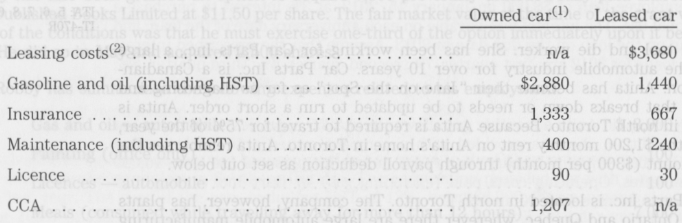
Due to her extensive travel, Anita's employer requires her to have an automobile for employment purposes. Anita has provided you with the following details of her automobile expenses.
NOTES:
(1) She owned an automobile until August 31, 2012, at which time she disposed of that vehicle and began leasing a new one. Assume that there are no tax consequences to Anita of the disposition of the automobile other than the fact that she can claim CCA in 2012 on this vehicle, as set out above, since it was a luxury vehicle.
Anita received an automobile loan to purchase the owned automobile. She received the loan on April 1, 2007, for $40,000, but has been making principal repayments annually on April 1 each year. She made the last principal repayment of $8,000 on April 1, 2012. There was no interest payable on the loan. Assume that the prescribed interest rate for employee loans was 6% for all of 2012.
During 2012, Anita drove the owned car a total of 40,000 kilometres, of which 35,000 kilometres were employment related.
(2) Anita leased the car as of September 1, 2012, at a cost of $920 a month that includes HST. The lease is for a three-year period that will expire August 31, 2015. At the time that she leased the car, the manufacturer's list price on the vehicle was $55,000 excluding all taxes.
During 2012, Anita drove the leased car a total of 20,000 kilometres, of which 18,000 kilometres were employment related.
REQUIRED
🔒
Unlock the complete assignment
You are viewing the free preview. Purchase this assignment once to reveal the complete resource.
$9.99 USD
Secure checkout is completed by Stripe.
(A) Determine Anita Flare's income from employment under Subdivision a of Division B of the Act for 2012, and cross-reference your answer to the appropriate section of the Act and/or Interpretation Bulletin. Round your answer to the nearest dollar. Ignore the effects of the leap year.
(B) Indicate why you did not include any of the above amounts in your answer with the appropriate cross-reference.
(C) Compute the HST rebate that should be claimed and the income tax consequences of the rebate to be received in 2013.
Car expenses(3) ......................................................................
9,837
9,837
$ 16,837
$ 16,837
Pars. 8(1)(h.1), (j)
Pars. 8(1)(h.1), (j)
$ 132,001
$ 132,001
(B)
Excluded items
(i)
The 25% of the monthly rent on Anita’s home in Toronto that she reimburses to the company does not form part of the taxable benefit calculation as it is not paid by her employer.
(ii)
Income tax withheld is not an allowable deduction under section 8 by virtue of subsection 8(2).
(iii)
CPP and El premiums paid are not an allowable deduction under section 8 by virtue of subsection 8(2), but these amounts will be allowed as tax credits under Division E.
(iv)
Contributions to the company group RRSP are not deductible under section 8 by virtue of subsection 8(2) but are deductible under section 60 of the Act subject to the applicable limits.
(v)
Group accident income protection insurance premiums are not deductible under section 8 by virtue of subsection 8(2).
(vi)
The monthly rent reimbursed by Anita to the company is not deductible under section 8 by virtue of subsection 8(2).
(vii)
The company payment of the board and lodging costs when Anita is out of town is not a taxable benefit as it meets the condition for exemption set out in subsection 6(6) because:
Her duties at these locations are temporary;
She maintains a principal place of residence at another location (toronto) that is available to her throughout her period of stay at these out of town locations and her principal place of residence is not rented to any other person during these periods;
Due to the distances involved, she could not reasonably be expected to return to her principal place of residence in toronto from these out of town locations on a daily basis; and
She is never at an out of town location for less than 36 hours.
(viii) The provision of boots and company uniform is not a taxable benefit by virtue of IT-470R, paragraph 29.
(ix) The company contribution to a registered pension plan is not a taxable benefit by virtue of paragraph 6(1)(a)(i).
(x) The fitness club membership dues paid by the company would not be taxable by virtue of paragraph 6(1)(a) if the membership is principally for the employer’s advantage than for Anita’s personal enjoyment [IT-470R, par. 34]. If the membership was determined to be principally for Anita’s personal enjoyment, the taxable benefit is $805.
(C) HST rebate
13/113 of section 8 deductions excluding zero-rated and exempt items: Car expenses deducted under pars. 8(1)(h) and (j) (see Note (3)).......................................................
13/113 of section 8 deductions excluding zero-rated and exempt items: Car expenses deducted under pars. 8(1)(h) and (j) (see Note (3)).......................................................
13/113 of section 8 deductions excluding zero-rated and exempt items: Car expenses deducted under pars. 8(1)(h) and (j) (see Note (3)).......................................................
Employment income inclusion in year of receipt of rebate [par. 6(8)(c)]:
$6,784 $902 = $781
$7,840
Capital cost reduction in year of receipt of rebate [par. 6(8)(d)]:
$1,056 $902 = $121
$7,840
The imputed interest is based on total days the loan is outstanding for 2010 excluding the day that the loan was actually repaid [31 + 28 + 31].
Anita’s contribution would be fully deductible if both her contributions and Car Parts Inc.’s contributions did not exceed the actuarially permitted amounts [par. 147.2(4)(a)].
Car expenses:
Acquired car
Acquired car
Leased car
Lease costs (see Note (a)) .................................................................
N/A
$ 2,668
Gasoline and oil ................................................................................
Deductible car expenses [pars. 8(1)(h) and 8(1)(j)]
Acquired car
35,000 km $6,028 40,000 km
$ 5,275
Leased car
18,000 km $5,045 20,000 km
$ 4,541
Total car expenses
$ 9,816
The car lease costs are subject to the restrictions in section 67.3.
Lease cost — Lesser of:
($800 1.13 122/30) – $0
= $ 3,676
$920 4 months $30,000 1.13 85% of the greater of :
$920 4 months $30,000 1.13 85% of the greater of :
= $ 2,668
(i) $30,000 1.13 100/85 = $39,882
(i) $30,000 1.13 100/85 = $39,882
(ii) $55,000
(a)
(b)
(b): The imputed amount of interest is deductible by virtue of section 80.5. The amount is subject to the restriction under section 67.2 that is the lesser of $900 (i.e., $300 90/30) and the $118 deemed paid. The lesser amount is $118.